 |
| photo from the Kalamazoo Public Library |
I always learn something at the library. That’s why I keep going. And the more I learn, the more I want to learn or, as Socrates said, “The more I learn, the more I learn how little I know”.
Wasn’t that the truth at the Herbert Hoover Presidential Library in West Branch, Iowa today. Just getting to the library was a journey but when I started reading about Hoover’s life and work it blew my mind.
Before today’s ‘aha moment’, whenever I heard Hoover's name I sang the ‘Herbert Hoover’ song from Annie. Remember? Annie and Sandy at the hobo camp?
"We'd like to thank you Herbert Hoover,
you made us what we are today...
today we're living in a shanty,
today we're scrounging for a meal,
today I’m stealing coal for fires,
who knew I could steal?”
I figured the lyrics to a Broadway show probably summed up everything I needed to know about Hoover; he was an unfeeling President who mishandled the Great Depression and failed the American people. Right?
Turns out, Herbert Hoover was a little more complex than his song. While it’s true that he might not have been the best leader during our country’s greatest financial crisis, he was a great humanitarian, famous and revered for his unrelenting assistance to people caught in the crossfire of WWI. Not surprisingly, I learned all about Hoover’s heroic side in gallery two, The Humanitarian Years.
Ambassador Walter Hines Page called Hoover "a simple, modest, energetic little man who began his career in California and will end it in heaven."
In 1920, the New York Times ranked Hoover as one of the ten greatest living Americans.
Franklin D. Roosevelt, Hoover’s D.C. neighbor, wrote, "He is certainly a wonder, and I wish we could make him President of the United States. There could not be a better one."
And if I hadn’t been to the library in West Branch I would have missed the whole story.
Wasn’t that the truth at the Herbert Hoover Presidential Library in West Branch, Iowa today. Just getting to the library was a journey but when I started reading about Hoover’s life and work it blew my mind.
Before today’s ‘aha moment’, whenever I heard Hoover's name I sang the ‘Herbert Hoover’ song from Annie. Remember? Annie and Sandy at the hobo camp?
"We'd like to thank you Herbert Hoover,
you made us what we are today...
today we're living in a shanty,
today we're scrounging for a meal,
today I’m stealing coal for fires,
who knew I could steal?”
I figured the lyrics to a Broadway show probably summed up everything I needed to know about Hoover; he was an unfeeling President who mishandled the Great Depression and failed the American people. Right?
Turns out, Herbert Hoover was a little more complex than his song. While it’s true that he might not have been the best leader during our country’s greatest financial crisis, he was a great humanitarian, famous and revered for his unrelenting assistance to people caught in the crossfire of WWI. Not surprisingly, I learned all about Hoover’s heroic side in gallery two, The Humanitarian Years.
- When the war broke out in 1914, 120,000 Americans were literally trapped in Europe. On August 3rd, Hoover got a call from the US Ambassador in England begging for help. Hoover rallied his rich buddies and within 24 hours the Savoy Hotel was turned into a distribution center and cafeteria. Hoover, his friends and the US Government loaned $1.5 million to the stranded travellers. With the exception of $400, he was paid back every cent and the experience reinforced his faith in the American character.
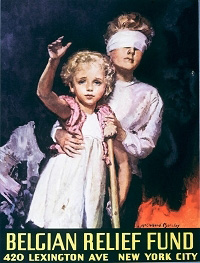
- The next war related crisis was in Belgium. Hoover created the Commission for the Relief of Belgium, a $12 million a month endeavor to save Belgians from starvation (thanks to its geography wedged between the Germans and the British Blockade). He told a friend that his fortune could, "go to hell" and embarked on the great undertaking without pay. He bought food from around the world, crossed the North Sea more than forty times to try to persuade each side to allow food to reach the victims and taught the Belgians that cornmeal was not just for cattle. The CRB is estimated to have save 10 million people from starvation.
- Hoover and his wife, Lou Henry, didn’t stop in Belgium. They went on to feed millions of starving children in France, founded the European Children's Fund, the National Committee on Food for Small Democracies, the Finnish Relief Fund, the Polish Relief Commission and the Famine Emergency Committee. Hoover even convinced Congress to spend $20 million to prevent famine in Russia under the new Bolshevik regime. The exhibit shares a story from a Latvian child who had lived for a year on black bread and crackers. "It was like the sun coming out," she recalled of the Sunday morning she first sampled white rolls. "Finally bread, Hoover's bread. I will never forget. Whenever anyone mentions Hoover, I think white bread."
Ambassador Walter Hines Page called Hoover "a simple, modest, energetic little man who began his career in California and will end it in heaven."
In 1920, the New York Times ranked Hoover as one of the ten greatest living Americans.
Franklin D. Roosevelt, Hoover’s D.C. neighbor, wrote, "He is certainly a wonder, and I wish we could make him President of the United States. There could not be a better one."
And if I hadn’t been to the library in West Branch I would have missed the whole story.

