Friday, July 8, 2011

Hoover's Giant Scrapbook

Associated Press Photo
Even though Herbert Hoover was born in West Branch, Iowa, where his Presidential Library now stands, his intellectual life started in California, at Stanford University where he, and his wife to be, were members of the first graduating class.

Hoover graduated from Stanford with a degree in engineering and went to work as a mining engineer for Bewick, Moreing & Co.  His work in gold mines took him around the world before he started Zinc Corporation and later became an independent mining consultant.  His mining lectures at Columbia and Stanford were recorded and have become the standard mining textbook.

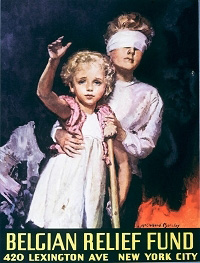
Hoover left his mining career behind in August  of 1914.  He was ready for a change of pace and his success in mining gave him the chance to dedicate his life to the war relief effort (see yesterday’s post).

On one of his many trip to Europe,  Hoover read the autobiography of Andrew White.  White was a historian and the first President of Cornell University who had gathered a huge collection of materials on the French Revolution.  The materials gave scholars and historians a clear picture of the events and characters of the Revolutions. White was an inspiration to Hoover and the book convinced him to start collecting as many war records and documents as he could get his hands on. 

In 1919 Hoover donated $50,000 to Stanford to create a home for his collection, originally called the Hoover War Collection and collecting began in earnest.  Historians joined Hoover abroad and were enlisted to collect materials in Russian, Germany and Central Europe and France.  

The Hoover Institution’s website explains, “The emphasis was on saving materials that would ordinarily be quickly lost: publications intended to respond to a specific historical moment, eyewitness accounts of historical events, correspondence and memoranda by public figures, and files of international humanitarian organizations. Posters, film footage, and photographs were important components of the collection from the beginning. Most of the materials required special care and handling. Hoover was prescient in collecting source materials on ideologies such as fascism, communism, and nationalism, which he saw shaping the new global politics.”  

In 1923 the name of the collection was changed to the “Hoover War Library” and by 1929 it had more than 1 million items and was bursting at the seams.  Finally, in 1939 plans were made to build a dedicated space for the library which resulted in Hoover Tower, dedicated in 1941.  Hoover’s collection was  “the largest private repository of documents on twentieth-century political history.”  

Hoover said, “here are the documents which record the suffering, the self-denial, the heroic deeds of men. Surely from these records there can be help to mankind in its confusions and perplexities, and its yearnings for peace.”  Hoover’s desire that the collection be used for research and policy making and peace was reflected in the library’s final name change to the Hoover Institution on War, Revolution and Peace.

Hoover summarized the mission of his Institute in 1959:

"This Institution supports the Constitution of the United States, its Bill of Rights and its method of representative government. The overall mission of this Institution is, from its records, to recall the voice of experience against the making of war, and by the study of these records and their publication, to recall man's endeavors to make and preserve peace, and to sustain for America the safeguards of the American way of life. This Institution is not, and must not be, a mere library. But with these purposes as its goal, the Institution itself must constantly and dynamically point the road to peace, to personal freedom, and to the safeguards of the American system."

Hoover’s archives are more than enough to demonstrate the futility and horror of war, yet, as a country it is a lesson we haven’t yet taken to heart.  No matter how much we see and understand, we can’t seem to stay on Hoover’s road to peace.

Thursday, July 7, 2011

The Real Herbert Hoover

photo from the Kalamazoo Public Library
I always learn something at the library.  That’s why I keep going.   And the more I learn,  the more I want to learn or, as Socrates said, “The more I learn, the more I learn how little I know”.

Wasn’t that the truth at the Herbert Hoover Presidential Library in West Branch, Iowa today.  Just getting to the library was a journey but when I started reading about Hoover’s life and work it blew my mind.

Before today’s ‘aha moment’, whenever I heard Hoover's name I sang the ‘Herbert Hoover’ song from Annie.  Remember?  Annie and Sandy at the hobo camp?
  
"We'd like to thank you Herbert Hoover,
you made us what we are today...
today we're living in a shanty,
today we're scrounging for a meal,
today I’m stealing coal for fires,
who knew I could steal?”

I figured the lyrics to a Broadway show probably summed up everything I needed to know about Hoover; he was an unfeeling  President who mishandled the Great Depression and failed the American people.  Right?  

Turns out, Herbert Hoover was a little more complex than his song.  While it’s true that he might not have been the best leader during our country’s greatest financial crisis, he was a great humanitarian, famous and revered for his unrelenting assistance to people caught in the crossfire of WWI.  Not surprisingly, I learned all about Hoover’s heroic side in gallery two, The Humanitarian Years.
  • When the war broke out in 1914, 120,000 Americans were literally trapped in Europe.  On August 3rd, Hoover got a call from the US Ambassador in England begging for help.  Hoover rallied his rich buddies and within 24 hours the Savoy Hotel was turned into a distribution center and cafeteria.  Hoover, his friends and the US Government loaned $1.5 million to the stranded travellers.  With the exception of $400, he was paid back every cent and the experience reinforced his faith in the American character.
  • The next war related crisis was in Belgium.  Hoover created the Commission for the Relief of Belgium, a $12 million a month endeavor to save Belgians from starvation (thanks to its geography wedged between the Germans and the British Blockade).  He told a friend that his fortune could, "go to hell" and embarked on the great undertaking without pay.  He bought food from around the world, crossed the North Sea more than forty times to try to persuade each side to allow food to reach the victims and taught the Belgians that cornmeal was not just for cattle.  The CRB is estimated to have save 10 million people from starvation.
  • Hoover and his wife, Lou Henry, didn’t stop in Belgium.  They went on  to feed millions of starving children in France, founded the European Children's Fund, the National Committee on Food for Small Democracies, the Finnish Relief Fund, the Polish Relief Commission and the Famine Emergency Committee.  Hoover even convinced Congress to spend $20 million to prevent famine in Russia under the new Bolshevik regime.  The exhibit shares a story from a Latvian child who had lived for a year on black bread and crackers. "It was like the sun coming out," she recalled of the Sunday morning she first sampled white rolls. "Finally bread, Hoover's bread. I will never forget. Whenever anyone mentions Hoover, I think white bread."
Hoover was a hero, known around the world for coming to the rescue of the neediest citizens in the world.  
Ambassador Walter Hines Page called Hoover "a simple, modest, energetic little man who began his career in California and will end it in heaven."   
In 1920, the New York Times ranked Hoover as one of the ten greatest living Americans.
Franklin D. Roosevelt, Hoover’s D.C. neighbor, wrote, "He is certainly a wonder, and I wish we could make him President of the United States.  There could not be a better one."

And if I hadn’t been to the library in West Branch I would have missed the whole story.

Wednesday, July 6, 2011

Rant Supported by Research

photo from Library Research Services

After my recent rant about the effects of cutting school libraries, I was gratified to hear Keith Curry Lance talking with Bob Edwards.  It turns out my passion was supported with solid, irrefutable data (I love it when that happens).   

Lance is a sociologist from the University of Colorado who has been conducting research on school libraries for almost 20 years since he founded the Library Research Service.  The LRS provides an amazing repository of facts and data for schools, library, the media and, even lowly bloggers like me, to use in support of their humble opinions.  

For instance, in 2006, before the recession hit, library use was steady and trending downward.  By 2008 library use began to rise and visits per capita at libraries in Colorada grew by 5% a year.  The same trend was apparent with library circulation and attendance at library programs.  Library computer use during the recession grew a whopping 11%.  The website puts all the data together in attractive flyers with colorful graph and charts that are just perfect for posting,  handing to your town councilman or mailing to your state senator.

The heart of Lance’s research are studies he conducted first in Colorado and then around the country to determine the impact of school libraries on student achievement.  If you’d rather watch than read, you can check out the 7 part video at the LRS website (wouldn’t these clips be great at a school board meeting?)  

The original Colorado study found that the size (in staff and collections) of the library was a direct predictor of student’s reading scores.  Wow.  I’m not a PHD but I think it would be safe to say that eliminating the librarian and leaving the collection to gather dust would also have an impact on test scores?
The indirect predictors were professional librarians who played an instructional role, higher levels of library spending and socio-economic factors.

What else has an impact on library quality and student acheivement?
  • collaboration between librarians and teachers
  • student / librarian ratio
  • library spending
  • active librarians who are school leaders
  • librarian that help students and teachers find the best materials
  • computers with remote access to library resources
Before you blame the results on pure socio-economics, you should know that after the original study, Lance and his team designed controls in their findings for poverty, demographics, teacher quality, parent education, student/teacher ratios and spending per student.

What can a good librarian, with a great collection do to make a difference in student’s lives?  Here’s one of Lance’s examples:

Barbara St. Clair,  from Urbandale High School in Iowa, tells this story about her job as librarian:  

“During the second week of school I visited every 9th grade classroom. I introduced students to the library and booktalked all 16 Iowa Teen Award books for this year. I keep them in a special place and as soon as one comes back it is checked out again, which makes me very happy. I gave each student a bookmark with the titles and each English teacher a poster about the books. Another English teacher at a different level said that he had heard that I gave really good book talks and asked me to pick out some books to present to his basic English class.”

Dedication, caring and knowledge add up to librarians who make a difference in the lives of our kids.

Tuesday, July 5, 2011

Exile

Schiffrin and Wolff in the Pantheon apartment
The Nazi occupation of Paris, and a narrow escape from a concentration camp, didn’t slow Jacques Schiffrin down.  According to David Kirkpatrick, in an article in the NYT Book Review, when Schiffrin settled in New York City he joined Kurt and Helen Wolff to begin began Pantheon Books, a small publishing house that translated European literature.  

The company began in the Wolff’s apartment in 1942 and focused on translating European books.  Pantheon grew and prospered over the next twenty years under the direction of Schiffrin and the Wolffs and in the 1960s it was purchased by Random House and moved into the Knopf division.

Meanwhile, back at the ranch, little Andre Schiffrin grew up in New York City surrounded by intellectuals and books and, upon graduating high school, attended Yale.  

In a wonderful interview in The White Review Andre explains how he began his career in publishing.  It started as a summer job at New American Books and, although he was not on the editorial staff, he suggested that the company consider publishing inexpensive paperbacks of the classics, with critical introductions, that could be used in schools (wait, doesn’t this sound familiar?).  The series eventually became the very popular Signet Classics.  In the book, The Business of Books, Schiffrin claims that, at the time, he never considered the fact that he was following in his father’s footsteps.

In 1961 Pantheon offered Andre Schiffrin a position as a junior editor and he began work down the hall from his father’s old office (Jacques died in 1950 when Andre was only 15).  Over the decades Schiffrin discovered and published many new authors like Noam Chomsky and Michael Foucault and Pantheon became known for supporting intellectual, and often leftist work, into the 1980.  

The history of Pantheon reads like a soap opera through the 1980s but basically, Andre was forced to resign his position because he would not downsize or reduce the number of titles he printed.  The entire episode seems to have been a power struggle between Andre and the new Random House boss, Alberto Vitale and big names like Kurt Vonnegut, Studs Terkel and E.L. Doctorow came to Schiffrin’s defense.

In 2000, Schiffrin published a memoir, The Business of Books: How International Conglomerates Took Over Publishing and Changed the Way We Read, by the title it seems that he got the last word in the dispute.

Pantheon continues to publish books but, depressingly, has expanded into graphic novels.  One of it’s current popular titles is about a rabbi and his talking cat.  La Pleiade continues to publish it’s elegant, well respected volumes of classic world literature, accompanied by critical notes and essays.  And Andre Schiffrin now oversees The New Press, a publishing house acclaimed from taking risks and tackling tough issues.  

It seems like, in the end, everyone got what they wanted thanks to Jacques Schiffrin.  It’s too bad he can't make a return visit to see his legacy.

Monday, July 4, 2011

La Pleiade

Edmund Wilson didn’t exactly invent the idea of creating the Library of America (see yesterday’s post), he borrowed and adapted it, which is how most great ideas start off.  

Wilson was inspired by the Bibliotheque de la Pleiade, a series of classic French books.  This collection of readable paperbacks, now numbering more than 500, includes mostly French books but also some world literature and philosophy.  Eleven new titles are released each year.

If you’re a collector, especially a book collector, I suggest you stop reading immediately.  The series is extremely enticing for those of us who enjoy gathering sets of anything, beautiful books or precious decorative objects.  I was first hooked by the color coded system:  20th century is tobacco (their color word, not mine), 19th century - emerald green, middle ages -  purple, antiquity - green, etc.  I can just imagine the leather-bound rainbow sitting on my living room shelf, after I read them, of course.

The series was born in 1923 when Jacques Schiffrin, a Russian Jew, moved to Paris and began a publishing company called ‘Editions de la Pleiade’.  His idea was to republish French classics in affordable leather volumes that people would enjoy reading.  At the time it was an exciting new idea and Schiffrin produced volumes by Baudelaire, Voltaire, and Stendhal.  When Schiffrin ran into money troubles in the 1930 he was bailed out by the larger publishing company Gallimard and Schiffrin was able to stay on as publisher.  

Interestingly, the history of La Pleiade, on the Gaillimard website, notes that Schiffrin remained as publisher until the beginning of World War II when Jean Paulhan ‘took over’.  They neglect to mention that Schiffrin was forced to resign because of the 1940 Nazi occupation of Paris.  

While the city was occupied,  The French Government was established in Vichy, an unoccupied territory of France and one of their first laws was that “foreign nationals of the Jewish race” would be held in a “special concentration camp”.  Schiffrin and his family made the wise decision to escape and went first to Casablanca and then onto New York.  His son, Andre was only five years old at the time.  Andre, now a famous publisher in his own right,  later wrote a book about the experience called,  A Political Education, Coming of Age in Paris and New York.  

La Pleiade continues on today as a Gallimard Publishing project.  They have published 531 books from 195 authors.  The texts are based on original manuscripts and are printed on delicate Bible paper and bound in leather volumes with gold lettering.  They are Jacques Schiffrin’s lasting legacy and gift to the world.  

Saturday, July 2, 2011

A Library is Born

Steinbeck's LOA collection

In the 1970s scholars, critics and book lovers were worried.  So much of America’s great literature was out of print or hard to find.  They wanted to preserve America’s literary legacy in a permanent way and create a physical collection of books that readers would treasure.

Years before, literary critic, Edmund Wilson (see yesterday’s post) came up with an idea to create a series of American classics using La Bibliotheque de la Pleiade as a model.   The Pleiade is a series of compact leather bound books, mostly written originally in French, re-published as a collection.  The series began in 1930 and continues today, adding 11 books each year.  

When the Ford Foundation and the National Endowment for the Arts offered the Library of America support in 1979 the printing presses were fired up and the massive project was off and running.

When I first imagined gathering American classic literature I pictured myself scouring through yard sales, used book tables at the library, ebay listings and attics.  I thought of tattered Penguin classics and musty, yellowed pages.  This is how I amassed my collection of American classics, but not what the Library of America had in mind.  In fact, it is the exact opposite.

The LOA collection is special for a few reasons:.

Quality Book Making.  The books are printed on acid-free paper that will not yellow or get brittle.  Binding are sewn, not glued, and are bound so that they lie flat when opened instead of getting all crinkly.  The binding is strong but the books are light despite having an average of 1,000 pages.  The publishers wanted to ensure that the books would be easy to carry and actually READ, not just be used for decoration.  Each book also has a  jacket and includes my all time favorite book feature:  an integrated ribbon bookmark.

Original Text.  The Library of America has made a commitment to restore each text to its original, unedited form.  Each text is traced back to its origins and scholars examine the pre-published copy, galleys and author letters to ensure that the LOA text is unabridged and presented as the author intended.  Sort of like taking a trip into the author’s attic and uncovering their notes and first drafts, except there’s no dust.

The LOA website points to some exciting discoveries they made during this process.  While researching Richard Wright’s Native Son, they found that several passages had been taken out because of their racial, political or sexual content.  And in preparing William Faulkner’s inclusion in the collection, publishers worked directly from his manuscripts and typescripts.

Author Info.  I love reading author blurbs at the back of a book.  It gives me a bigger picture of the story and an understanding of the time and place that the text came form - and I love when a picture is included.  The LOA agrees.  Each volume includes a timeline of the author’s life and work, helpful notes about the text and an academic essay on the work.  It’s like getting a mini literature course for each reading.

There is a problem with including all these “extras”.... it makes the books too expensive to buy.  Because the LOA is non-profit and their mission is to preserve the texts for people to read, they actually sell the books for LESS than they cost to make.  Imagine.  Although they got start up money from the Ford Foundation and the NEA for the first three years, they no longer are supported by any government agency or foundation.  All their funding comes from grants, donations and book purchases.  

Yale professor, J.D. McClatchy speaks about American writers in a video at the LOA site, as determined “loners” who offer a window into the extremes of our history and the LOA volumes as “uniform stones” that make up a great entryway into who we are as Americans.  When you see all the volumes, separate but joined together by our common nationality it is like peering into the melting pot of our country before the ingredients were combined.  

This growing library is a treasure beyond words that will forever remind us that we are a culture of readers, writers and thinkers and our books are our temples.

Friday, July 1, 2011

Strange Bedfellows

Wilson's Library of America Volume

The first thing you need to know is that  The Library of America is not a place, like the Mall of America,  it’s a publishing company, a non-profit publishing company that began in 1979 with grants from the Ford Foundation and the National Endowment for the Arts.  

The LOA is a library of America’s great works of literature that have been republished to preserve their beauty and integrity..

The next thing you should know is that although I really tried to admire Edmund Wilson, one of the literati that dreamed of creating the LOA, it was impossible.  

When I start reading about someone new (which is almost everyday) my opinion is flexible, like jello before it sets.  As I sift through stories, pictures and facts my brain jello firms up and by the end of the evening I have a pretty good mold, nothing fancy, but definitely solid.  It’s just like going on a first date, by the time you get home, you just know if there’s going to be a second date.

I really admired Wilson’s idea of gathering up American classic literature and publishing it in a beautiful library to be cherished and read for generations (he was actually inspired by the French Bibliotheque Pleiade, but that’s a story for later in the week), so I was all set to add him to my list of book heroes.  

My first red flag popped up when I read that he referred to The Lord of the Rings as “juvenile trash”.  Then I learned that he wrote that Orwell was “inconsistent and provincial”.  In fact, he regularly offered harsh words about books that are now accepted classics, required-reading-list books in school across the country.  I reminded myself that Wilson was a book critic and he was writing about these authors in the 1930s and 40s, the authors were contemporaries, not legends.  At the time the books were brand new, certainly not the classics that I spent many hours learning to revere and respect.  I tried not to be a Monday morning quarterback.   

Wilson, on the other hand, was not doing much to earn my respect.  The events of his life were flowing together like an oil spill in a nature reserve...destructive and dirty.  Curmudgeon was a popular word to describe his personality, but he was also an alcoholic, a snob, a tax evader, a womanizer (his first fling was with Edna St. Vincent Millay) and was know for his rudeness.  Four marriages did not prevent him from constantly cheating and at 70 he was still chasing skirts (ewww).  

So why exactly is Wilson still remembered and appreciated?  He was a brilliant literary critic, an author, a journalist and provided a powerful social commentary of his times.  Wilson was born in 1895 and lived a charmed life including; prep school, Princeton (as a classmate of  F. Scott Fitzgerald), summer estates and European adventures.  He served in the Army during WWI before becoming the editor of Vanity Fair, assistant editor of The New Republic and book reviewer for The New Yorker and The New York Review of Books.

Although he was a writer, his greatest influence was as a literary critic.  Wilson’s intellect and writing skill led to his reputation as one of the great American critics.  He wrote some of the first reviews of Ulysses, The Waste Land and Yeats, promoting him as a important poet.  He also supported Hemingway and Fitzgerald’s writing and was on target with his perceptions of E.E. Cummings and Wallace Stevens.   He wrote prolifically and his opinions were scattered across decades of great American writing.

Wilson is the kind of guy modern women would back away from quickly.  If fact, I can’t imagine many men or women who would enjoy his volatile company at all.  Maybe this is why he spent so much time reading and writing about books, alone with a bottle in his summer estate, perhaps he was more of a tragic figure than a villain?   Whatever his motivations, his passion for books led to the creation of the Library of America, a beautiful collection of books, that continues to grow and preserve our country’s great thoughts, ideas and stories.  For that he has my grudging respect and admiration.